
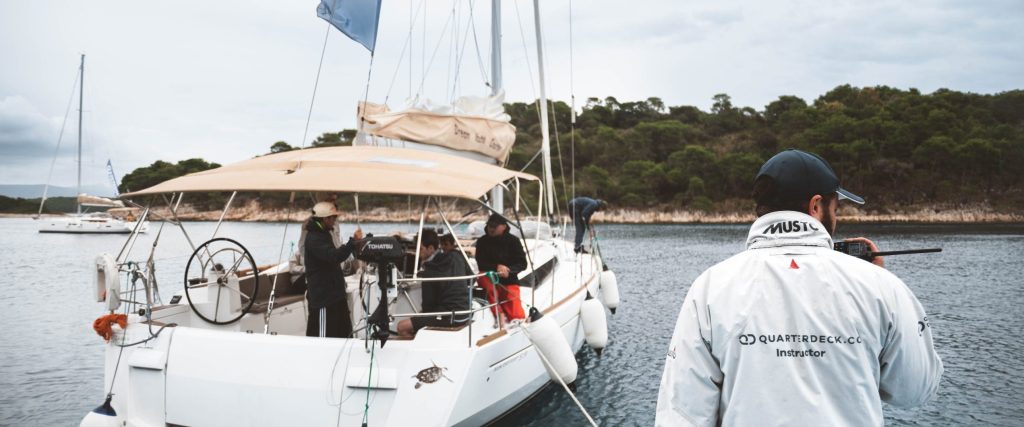
Skipper Curriculum
The Skipper Academy curriculum covers what it takes to run a charter yacht with paying guests onboard. Over seven days on the water, students develop yacht handling under power, Med mooring, anchoring and rafting, engine checks, safety briefings, damage avoidance, and the leadership side of the role: briefing a crew, working with a host and making decisions when conditions or plans change.
Skipper Academy is built for sailors who can already sail. The curriculum does not teach you to sail. It teaches you to skipper.
What You Will Learn on the Skipper Course
The curriculum is organised around six competency areas. Each one reflects a part of the skipper’s real working week on a 40-60ft charter sailing yacht.
Navigation and passage planning:
Planning each day’s route with safety, conditions and guests in mind.
Yacht handling and manoeuvring:
Controlling the yacht under power in marinas, anchorages and rafts.
Sailing skills and yacht operations:
Sail handling, engine checks and keeping the yacht in safe working condition.
Safety and emergency procedures:
The pre-departure safety briefing, risk awareness and preventing damage.
Weather and meteorology:
Using weather information to make itinerary and safety decisions.
Crew management and skipper responsibilities:
Leading the crew, briefing guests and working as a unit with the host.
Navigation and Passage Planning
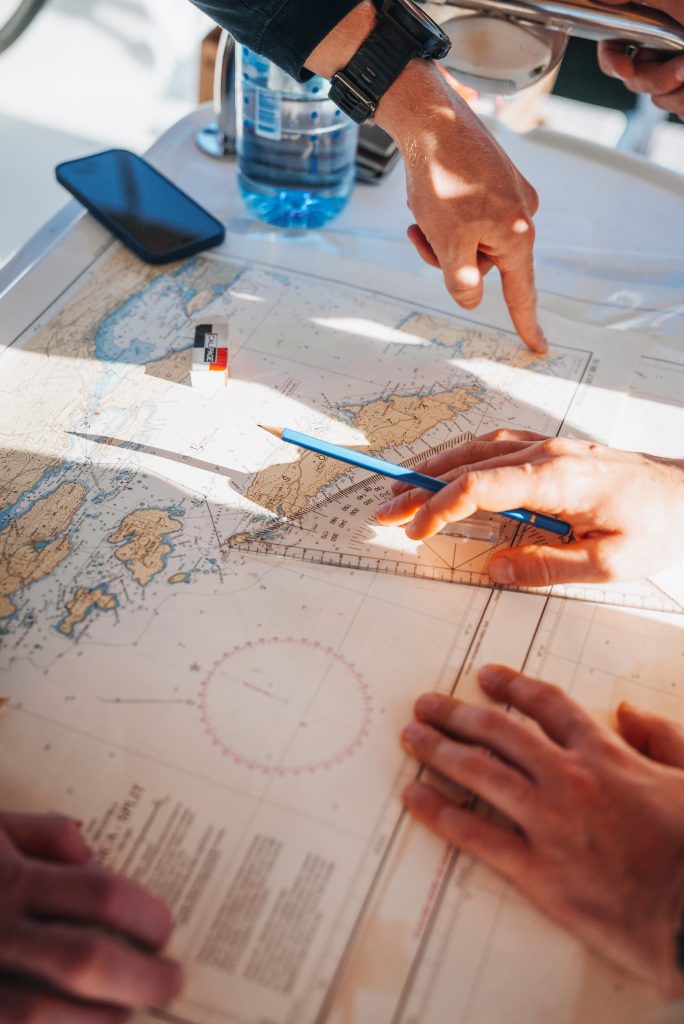
On a charter week, the skipper plans every leg: where to go, when to leave, where to anchor or moor, and what to do if the plan no longer works. The curriculum focuses on applying navigation knowledge to these decisions rather than on chart theory.
Students plan routes around the itinerary, available marinas and anchorages, known hazards and local harbours. The skipper has the final word on the itinerary whenever safety is involved, and part of the training is learning to explain that decision to guests calmly.
Yacht Handling and Manoeuvring
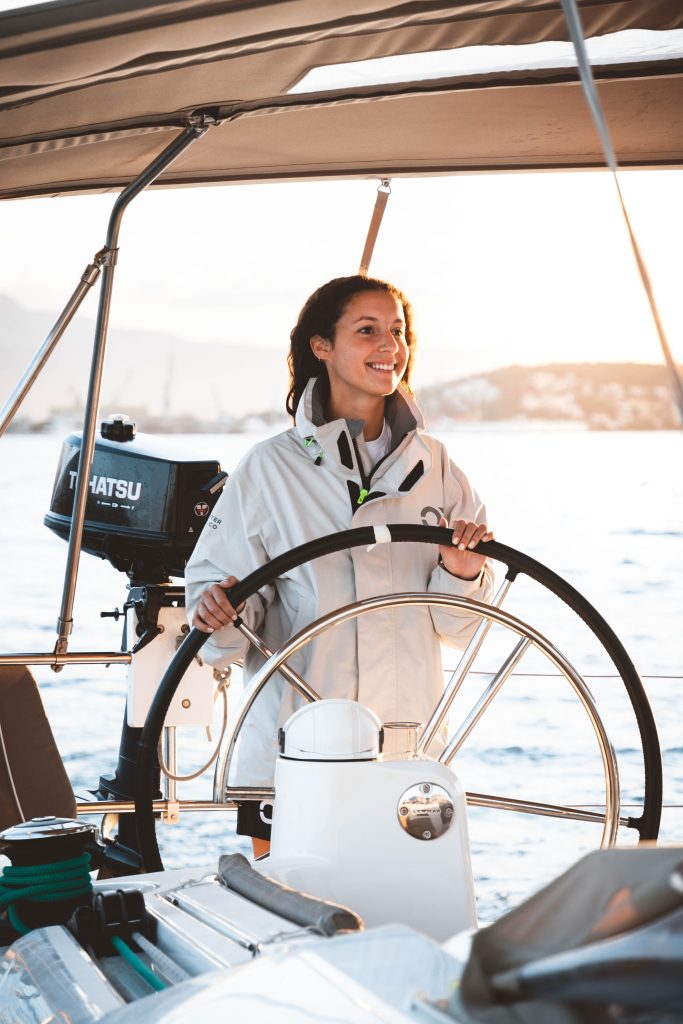
This is the largest part of the curriculum, because manoeuvring under power is what most clearly separates a skipper from a capable sailor. Students work through:
- Prop walk: confirming its direction on each yacht and using it deliberately rather than fighting it
- Reversing in a straight line: setting up the approach, stopping the yacht, and building rudder authority before steering
- Turning in a tight area: using short forward pushes and reverse to rotate the yacht in minimal space
- Med mooring: planning the approach, positioning the stern, getting the windward line on first, and fixing lines in the correct order
- Anchoring to land: dropping at the right point, running a shore line, and setting the anchor with the chain at the correct angle
- Joining and building a raft: using bow, stern and spring lines so the raft holds safely
- Leaving a raft on anchor: departing in the right order without fouling other yachts' anchors
- Alongside docking and departure: approaching slowly, setting fenders and lines, and using springs to leave the quay
Students do not watch these manoeuvres and move on. They plan, brief and carry them out themselves, repeatedly, with the instructor correcting technique after each attempt.
Sailing Skills and Yacht Operations
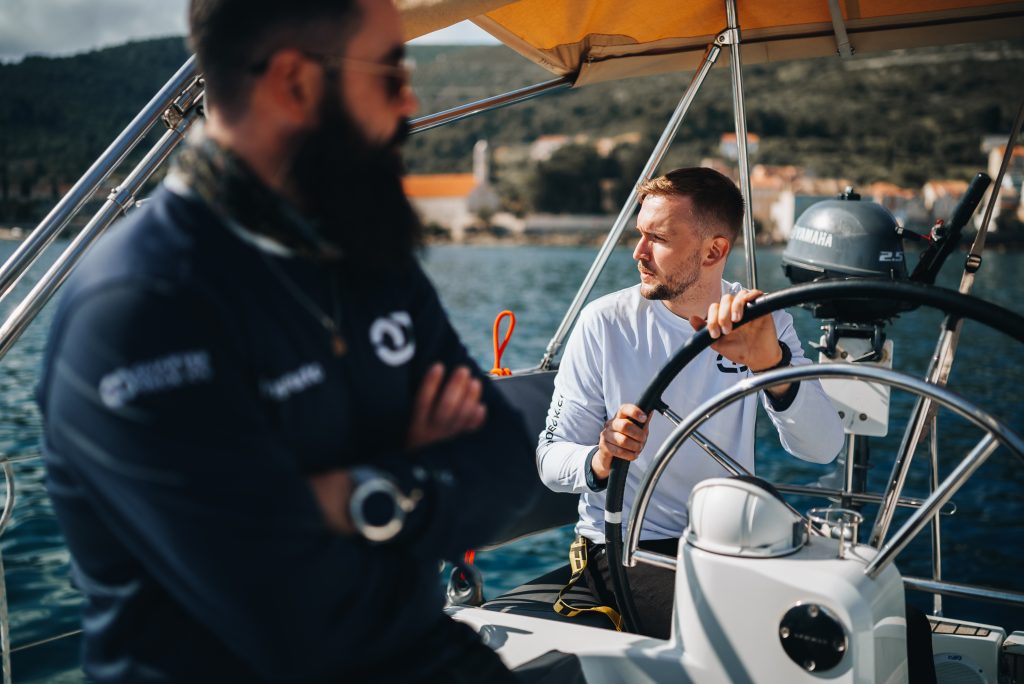
Students arrive knowing how to sail. The curriculum focuses on operating a yacht responsibly across a full charter week.
That includes sail handling that protects the yacht , such as furling the mainsail into the wind and taking care with electric winches, and the daily operational routine that keeps the yacht safe to use. Every morning starts with the WOBBLE engine check: Water, Oil, Belt, Batteries, Leaks and Exhaust. It takes two minutes and is standard across the Quarterdeck fleet.
Safety and Emergency Procedures
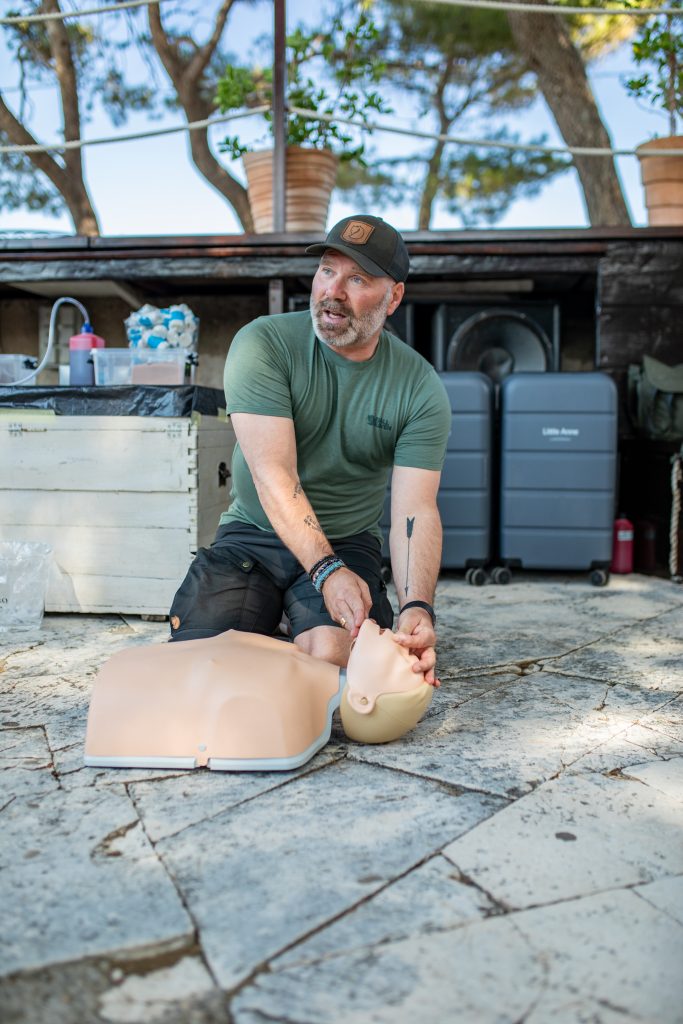
The safety part of the curriculum starts before the yacht the leaves marina. Students run the pre-departure crew briefing required under SOLAS regulations, covering lifejackets, harnesses and tethers, the life ring and danbuoy, flares, the life raft, fire extinguishers, bilge pumps and the emergency VHF procedure.
Beyond the briefing, students learn the habits that prevent incidents: a headcount before every departure, closing hatches before sailing, keeping lines clear of the propeller, and securing the dinghy, fenders and deck equipment. The curriculum covers the most common causes of charter damage and how a skipper prevents them, because the skipper is responsible for the yacht’s condition when it is returned.
Weather and Meteorology
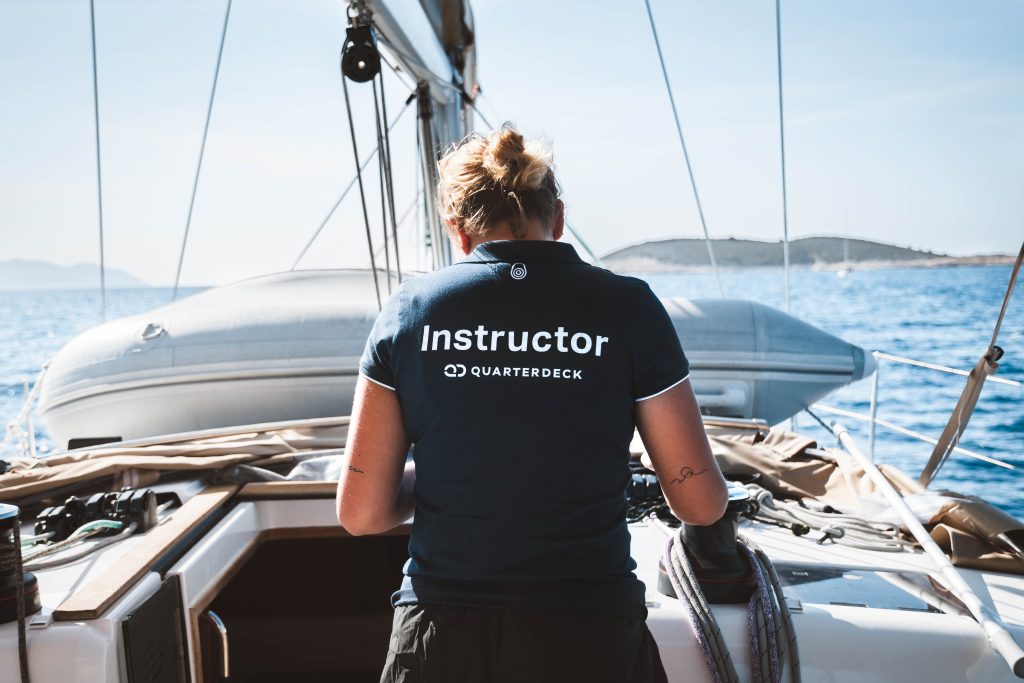
Weather knowledge is applied to skipper decisions throughout the week. Students are expected to arrive already familiar with reading forecasts for the region, and on the course that knowledge feeds directly into route choices, departure times, anchorage selection and the decision to change plans.
The focus is not forecasting theory. It is making a safe, well-explained decision and communicating it to guests who may be disappointed by it.
Crew Management and Skipper Responsibility
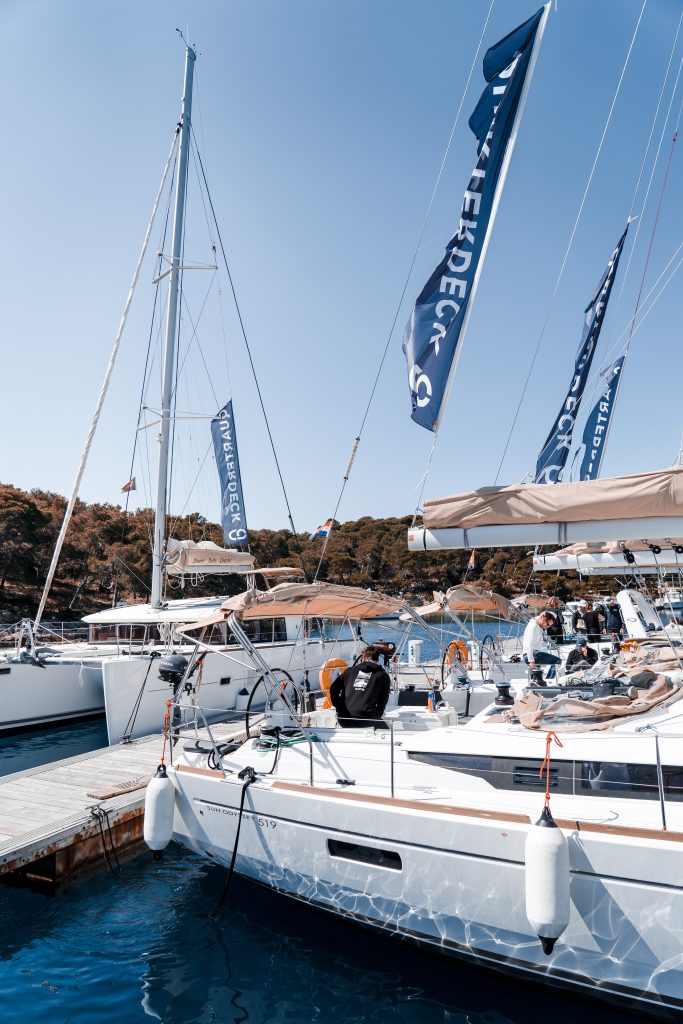
A skipper is a leader, not just the person at the helm. The curriculum covers:
- Running a clear, calm crew and guest briefing at the start of the week
- Delegating tasks such as anchor handling and fender work, and briefing crew before they touch the controls
- Taking responsibility for damage, including damage caused by unclear instruction
- Managing guest expectations, including the "under promise, over deliver" approach to check-in times
- Setting up the shared kitty for marina fees and fuel on the first evening
- Working with the host as one team, sharing tasks across the yacht
Skipper Academy runs alongside Host Academy. Skipper students work with host students during the week, which means the skipper-and-host relationship is practised in real conditions, not just discussed.
Theory and Practical Skipper Training
Theory on Skipper Academy exists to support what happens on the water. Before the course, students work through the Skipper Academy Pre-Course Preparation Guide: knots, VHF radio procedure, the WOBBLE engine check, and videos on prop walk, reversing and Med mooring.
On the course, the same concepts are carried out on real charter yachts. A student who has read how prop walk works then tests it in open water on a yacht they have never handled before. A student who has studied the SOLAS briefing then delivers it to a crew. Check-in day follows the real charter timetable, including the yacht inspection with the charter technician, before the yacht leaves for its first anchorage.
How the Skipper Curriculum Progresses
The week is structured so that each day builds on the one before.
Friday (Day 1)
Arrival, welcome briefing ashore, and an evening briefing that introduces the week and covers safety essentials.
Saturday
Check-in day on a real yacht. Students run the yacht inspection, complete the crew briefing and depart for the first anchorage
Sunday to Wednesday
Manoeuvring under power, Med mooring, anchoring, departure procedures, yachting etiquette and the full range of skipper responsibilities.
Thursday
Advanced scenarios. Higher-pressure situations, real-world problem solving and time to consolidate everything from the week.
Friday (Day 8)
Assessment and final debrief.
Throughout the week, students take turns at the helm and in crew roles. Repetition and instructor feedback after each manoeuvre are what turn a technique into a reliable routine.
Skipper Skills You Should Have by the End of the Course
By the end of Skipper Academy, students should be able to:

Navigation
Plan a day’s route around the itinerary, hazards and available moorings.
Yacht handling
Reverse in a straight line, turn in a tight area, Med moor, anchor with a shore line, and dock and depart alongside.

Passage planning
Decide when to leave, where to stop and what the fallback option is.

Safety
Deliver a full SOLAS crew briefing, carry out the WOBBLE engine check and apply damage avoidance habits across the yacht.

Weather
Use forecast information to make and explain itinerary decisions.

Crew management
Brief a crew clearly, delegate tasks safely and work as one team with a host.
Skipper decision-making
Stay calm, make a clear call and take responsibility for the yacht and everyone onboard.
How the Skipper Curriculum Prepares You for Assessment
Every part of the curriculum reflects a competency that is assessed. Students are assessed against Quarterdeck’s standards throughout the week, not only on the final day, and the final debrief gives each student an honest outcome.
For the assessment criteria, format and process, see Skipper Assessments.
What Makes Quarterdeck’s Skipper Curriculum Different?
It is taught on real charter yachts. Training takes place on working yachts in active charter areas, following a real charter week from check-in day onward.
It is built around the charter skipper’s actual job. The curriculum includes the parts of the role most sailing courses leave out: check-in inspections, guest briefings, the kitty, damage liability, flotilla rafting and working with a host.
It uses Quarterdeck’s own procedures. Students learn the WOBBLE engine check used across the Quarterdeck fleet and a set Med mooring routine, so they have something reliable to fall back on when conditions are difficult.
It is practised with a real host. Because Skipper Academy runs alongside Host Academy, students learn to work as a skipper-and-host team with other trainees who are cooking and hosting for real.
It starts before you arrive. Every student receives a pre-course preparation guide with homework, so time on the water is spent practising skills rather than learning basics.
Who Is the Skipper Curriculum For?
The curriculum is designed for experienced sailors preparing to work as professional charter skippers. Students typically arrive from Sailing Academy, from another sailing school, or from years of charter weeks.
If you do not yet have the sailing experience, start with Sailing Academy. Students who complete Sailing Academy move into Skipper Academy the following week.
For licences, age and eligibility, see Skipper Requirements.
From Skipper Training to a Yacht Career
The curriculum is one step in a wider pathway: training builds competence, competence is assessed, and students who reach the qualifying standard can move into professional skipper work. For those tracking placement, the final debrief becomes a conversation about next steps.
To see what professional skipper work involves, go to Skipper Jobs. For the full pathway, see Become a Skipper.
FAQ
Yacht handling under power, Med mooring, anchoring and rafting, alongside docking, engine checks, safety briefings, damage avoidance, and the leadership side of skippering: crew briefings, guest management and working with a host.
Prop walk, reversing, turning in a tight area, Med mooring, anchoring with a shore line, building and leaving rafts, alongside docking and departure, the WOBBLE engine check and the SOLAS crew briefing.
Yes, applied to real skipper decisions. Students plan routes, departure times and moorings around the itinerary, hazards and conditions. Foundational navigation is expected before the course and is covered in Sailing Academy.
Yes. Manoeuvring under power is the largest part of the curriculum, practised repeatedly on real charter yachts.
Mainly practical. Theory is covered through the pre-course preparation guide and briefings, then applied on the water throughout the week.
Each part of the curriculum reflects a competency that is assessed, and students are assessed throughout the week rather than only at the end.
You should be able to handle a 40-60ft yacht in marinas, anchorages and rafts, run a safety briefing, carry out daily engine checks, plan a charter day and lead a crew with a host.